
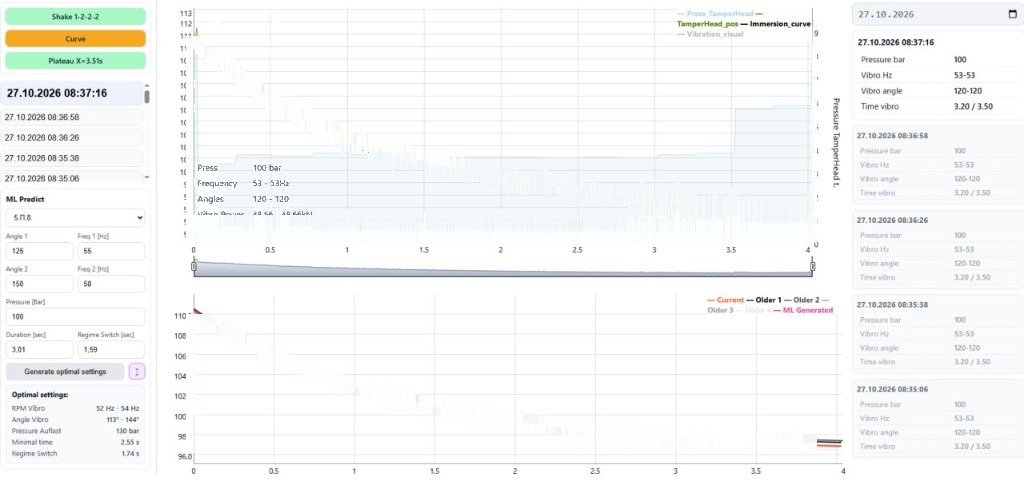

It reads the punch
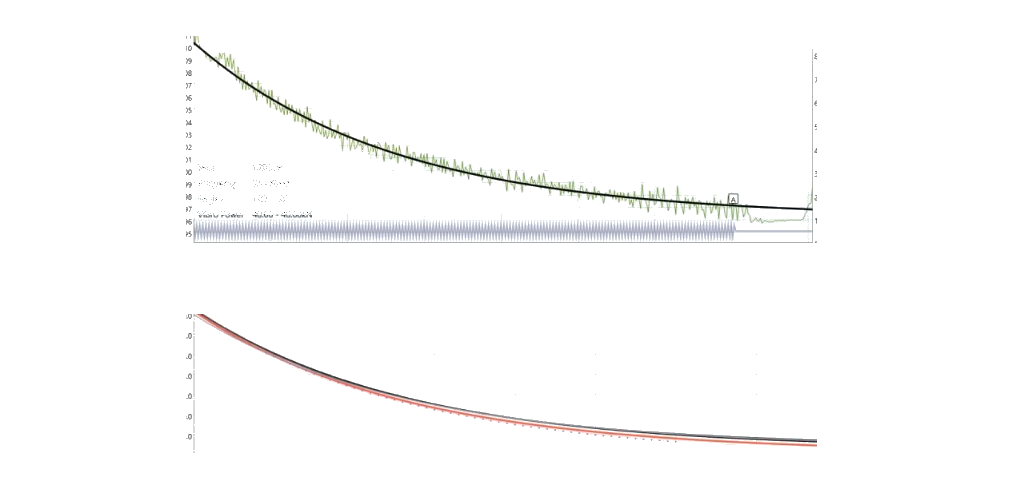
The system reads the punch position during the cycle, builds the immersion curve and determines the point where it reaches a plateau — after which further immersion has practically stopped.
Home / Solutions / QuatroIDA
QuatroIDA is a diagnostic and optimisation system for vibropressing. It shows the plant not the settings entered into the machine, but the actual behaviour of the process: where vibration no longer compacts the mix, and how evenly the vibrating table works across its four corners.
IN PLAIN WORDS
QuatroIDA helps the plant remove excess vibration from the cycle and control the condition of the vibrating table by measurement, rather than by ear or by indirect signs. It also reduces the dependence of the process on one particular experienced operator: decisions move from “by habit” into the field of measurements and clear recommendations.
The system reads the punch position during the cycle, builds the immersion curve and determines the point where it reaches a plateau — after which further immersion has practically stopped.
Four vibration sensors on the corners of the vibrating table. The system measures the actual movement, compares the corners with each other and rates the condition of the equipment.
The system is permanently installed at the plant and available every day — before a shift, after maintenance, when selecting settings. History accumulates instead of being captured during a one-day visit.
CLIENT VALUE
From our observations, vibration time can often be shortened by 0.5–1.5 seconds. On an average cycle of 18–20 seconds, that gives an indicative productivity gain of roughly 2.5–9%.
productivity gain
productivity gain
productivity gain
The exact effect depends on the product, the current settings, operator discipline and the condition of the equipment. It is easily verified on a pilot: real cycles are taken, the excess vibration time is counted, and it is converted into output.
WHAT WE MEASURE
RMS shows the averaged force of vibration over a short interval — useful for a quick assessment, but on its own it does not show the structure of the vibration. These five do.
Up-and-down movement of the table. The higher the indicator, the more energy goes into correct compaction.
Fore-and-aft rocking of the table. A low indicator means the table may be “nodding” on one edge.
Side-to-side tilt. A low indicator means the left and right sides are working unevenly.
A low indicator means the corners move out of step, as if the mould were twisting diagonally.
A low indicator can point to extra harmonics, play, impacts, imbalance or mechanical problems.
QuatroIDA records the signal at 5–10 thousand points per second. That makes it possible to analyse not only the average force of vibration, but the quality of the movement: how even, synchronous, vertical and stable it is.
WHO IT IS FOR
Together with QuatroPBC, the system gives the basis for remote press adjustment: PBC shows the result on the product, IDA shows the actual forming process.
Automatic control of the machine is the next stage. Today the focus is on measurement, recommendation and support for the operator: the system does not replace the technologist or the mechanic, it gives them a measuring instrument and clear diagnostics.
GET IN TOUCH
Send us your line details and we’ll arrange a tailored presentation and a live demo of the system inspecting a product like yours.


